 |
| Aliens: Earth War #2, July 1990. Artwork by John Bolton. |
Since 1991, I've had but one copy of Earth War - this one. So I have little to no idea what it's about. One day, I'll probably buy the rest, if only for John Bolton's fantastic covers.

|
| Aliens: Earth War #2, July 1990. Artwork by John Bolton. |
 |
| Concrete: Strange Armor #1, December 1997. Artwork by Paul Chadwick. |
"Strange Armor retells Concrete's origin and early struggles as a rocky freak among men.
Still smarting from a divorce, his dreams fading amid the abrasions of his life as a political speechwriter, Ron Lithgow takes off for a rare camping trip in the mountains.
Unluckily, he and a friend are kidnapped by aliens and have their brains transplanted in immense, rocky bodies. Only Ron escapes, and the aliens depart.
With help from Senator Mark Douglas, his boss and father-figure, Ron is secretly taken to the National Science Agency and becomes an object of study.It turns into a barely-acknowledged captivity.
After much ambivalence, and manipulation by Security Officer Joe Stamberg, Ron resolves to break out.
He is aided by Dr. Maureen Vonnegut, one of the biologists assigned to his case. They create a sensation on the streets of Washington D.C., and then on Nightline. Ron is dubbed "Concrete" and assumes a strange celebrity.
Stamberg's forceful bargaining has led to Ron - Concrete - agreeing to a cover story: he is, supposedly, sole survivor of a government cyborg project. Furthermore, Stamberg is to be his "handler."
But Stamberg has a secret plan. He meets with a shadowy Latin American and proposes hiring out Concrete's services, surely with a coercive threat in reserve to secure Concrete's cooperation."
 |
| Watercolour painting from the back cover of Strange Armor #1 by Paul Chadwick. |
 |
| Concrete: Strange Armor #2, January 1998. Artwork by Paul Chadwick. |
 |
| Watercolour painting from the back cover of Strange Armor #2 by Paul Chadwick. |
"I jump like a flea. I land like volcano ejecta. In fact, I have an astonishing capacity to hurt people around me."
 |
| Concrete: Strange Armor #3, March 1998. Artwork by Paul Chadwick. |
 |
| Watercolour painting from the back cover of Strange Armor #3 by Paul Chadwick. |
"Imagine having people's immediate, heartfelt reaction to you to be stark terror. What had I become?"
 |
| Concrete: Strange Armor #4, April 1998. Artwork by Paul Chadwick. |
 |
| Watercolour painting from the back cover of Strange Armor #4 by Paul Chadwick. |
"Two words. They made me want to turn around ... and rebury myself."
 |
| Concrete: Strange Armor #5, May 1998. Artwork by Paul Chadwick. |
 |
| Watercolour painting from the back cover of Strange Armor #5 by Paul Chadwick. |
"She looked at me as if I had lost my mind. I had, of course."
 |
| Aliens: Labyrinth #1 (of 4), September 1993. Cover by Kilian Plunkett. |
"As the first Alien film could be likened to a gothic horror story in outer space, Aliens: Labyrinth could be read as a murder thriller. The setting is a remote space station, where a group of scientists study behavioural responses in Aliens. The experiments are very carefully monitored, and ever safety precaution is considered, so the crew is genuinely shocked when a technician is killed by an Alien. A doctor suspects that the death may have not been an accident, and tries to uncover the truth. The murder investigation evolves into a deceiving, sinuous nightmare."
 |
| Art: Kilian Plunkett, Colours: Matt Hollingsworth. |
 |
| Aliens: Labyrinth #2 (of 4), October 1993. Cover by Kilian Plunkett. |
 |
| Art: Kilian Plunkett, Colours: Matt Hollingsworth. |
 |
| Aliens: Labyrinth #3 (of 4), November 1993. Cover by Kilian Plunkett. |
 |
| Art: Kilian Plunkett, Colours: Matt Hollingsworth. |
 |
| The Terminator: The Enemy Within #2, December 1991. Cover by Simon Bisley. |
 |
| Art: Vince Giarrano, Colours: Steve Buccellato. |
 |
| The Terminator: The Enemy Within #3, January 1992. Cover by Simon Bisley. |
 |
| Art: Vince Giarrano, Colours: Steve Buccellato. |
 |
| The Terminator: Secondary Objectives #3, September 1991. Cover art by Paul Gulacy. |
 |
| Pencils: Paul Gulacy, Inks: Karl Kesel, Colours: Gregory Wright. |
 |
| The Terminator: Secondary Objectives #4, October 1991. Cover art by Paul Gulacy. |
 |
| Pencils: Paul Gulacy, Inks: Karl Kesel, Colours: Gregory Wright. |
 |
| Front dust-jacket cover, painting and Tribes logo design by David Dorman. |
"The Queen is Dead
An orbiting medical facility infested with an Alien scourge.
A military clean-up crew dispatched to destroy them.
A berserk warrior in a lethal exoskeleton with enough fire power to kill them all.
A race against time.
Long Live the Queen."
 |
| Rear of dust-jacket, painting by David Dorman. |
 |
| Painting by David Dorman. |
"Our Call is of a greater Need; know this: we are the Chosen, and so we do Choose: our only value is to the Queen Mother and her Swarm, to Her and Hers, is as I have Written: 'Protect and Proliferate'".-The Rev. Dr. Thomas Engstrom, Totem of The Queen Mother(Banned by Corporate Governor's decree)
 |
| Painting by David Dorman. |
 |
| Painting by David Dorman. |
"An Alien has been detected on board a space station orbiting Earth, and a crack extermination team sets out to destroy it. The success of their mission may be jeopardized by one man's sinister secret."
 |
| Panther SF/Grafton paperback, 1986. Illustration by Peter Jones. |
"The terrifying arms race roared on. Daily, East and West produced more dreadful weaponry. And, daily, yesterday's weapons were turned into toys, souvenirs, egg beaters, furniture...and never, never used as weapons. Which was just as well, since they wouldn't have worked.
It may have looked crazy, but it kept the 21st Century world peaceful and its population securely under the dominion of the monstrous, ubiquitous security agencies.
But then the Sirius Slavers arrived from outer space. Whole cities began to disappear. The world was defenceless - and the race for an Ultimate Weapon for survival was on, for real this time. The outcome meant life or death for Earth. And it lay in the hands of two misfit weapons 'fashion designers', a demented comic book artist and a highly unlikely toymaker from the wrong side of time..."
 |
| 1973 NEL Paperback. Artwork by Bruce Pennington. |
"A time when robots and romen carry out the tasks. A time when man gets along with man. In the skies float the R.S.P.C.R. men - Royal Society for the Prevention of Cruelty to Robots - and there seems to be little that can disturb the calm of 22nd Century man. That is, until a strange manuscript finds its way onto Birdlip's the publisher's desk.
Javlin is preparing for his bout in the arena. He is in a strange world of insect captors, watching the Games for their amusement. And he does not know that his partner against the dreaded yillibeeths is to be - a woman.
These are just two of the creations from the intergalactic pen of Brian Aldiss. They are always fresh, always amusing and always the best."
 |
| Coronet paperback, 1974. Acrylic sculpture by Haydon Williams. |
"Dimension X contains two complete short novels by two of the greatest names in modern science fiction.
Robert A. Heinlein's The Man Who Sold The Moon is a classic tale of a man obsessed by private vision. It's also a breathtakingly daring story of the ultimate in private enterprise...
The late, great C M Kornbluth's The Marching Morons makes 1984 look like the Golden Age with its bleak, horrifically funny vision of a future earth populated by morons with an average IQ of 45..."
 |
| Corgi paperback, 1962. Cover artist uncredited. |
"WAY OUT
around the fringes of consciousness Howard Fast found some ideas that were too bold and terrifying for the here and now. They leaped the barriers of time and imagination and found their place in some of the most startling, provocative science fiction stories ever written. Here, in time, space and the galaxy, is all the story-telling genius of the celebrated author of Spartacus."
 |
| Pan paperback, 1972. Artist uncredited. |
"Worlds of TomorrowAliens, on Earth and ElsewhereOther DimensionsDamon Knight has said that SF and prophecy are two different things. SF deals with what may be, not what will be. This superb collection allows the reader to enter worlds which exist nowhere else, to experience many things still undreamed of in earthly philosophy."
 |
| Artwork by Eric Peterson. |
"The Sleeper Awakes.
A nightman at a 24-hour quick-stop, Roland Pritchard's life is an unending parade of tedium, loneliness and despair. His only escape is into the fertile landscape of his dreams - a magical realm of demons, war and miraculous adventure - where he imagines himself to be a postulant in an isolated monastery...who, in turn, dreams of a dark urban world of violence and machines. In his sleep, the simple grocery clerk is much more than he could ever be...
But now something is happening that cannot be rationally explained. An extraordinary merging of nightmare and daydream is awakening Roland Pritchard to a wondrous, terrifying truth - that the two worlds and lives he inhabits are equally real...and equally deadly."
 |
| Orbit paperback, 1984. Cover art by Alan Craddock (thanks: Staz Johnson) |
"L M Greenspan, the head of ailing Climactic Studios, gave producer Barney Hendrickson, five days to get a major movie in the can - and Climactic out of it.
Impossible?
Not with Professor Hewett's miraculous presto chango time machine, the answer to a Hollywood producer's prayer.
Nipping back to AD 1,000 with a whole film crew and two glam stars, Barney sets out to prove that the Vikings discovered America five hundred years before Columbus - and to film the event in glorious technicolor. But it's not as easy as it sounds, as they realise when history lets them down and their Viking Columbus fails to show up in the new world..."
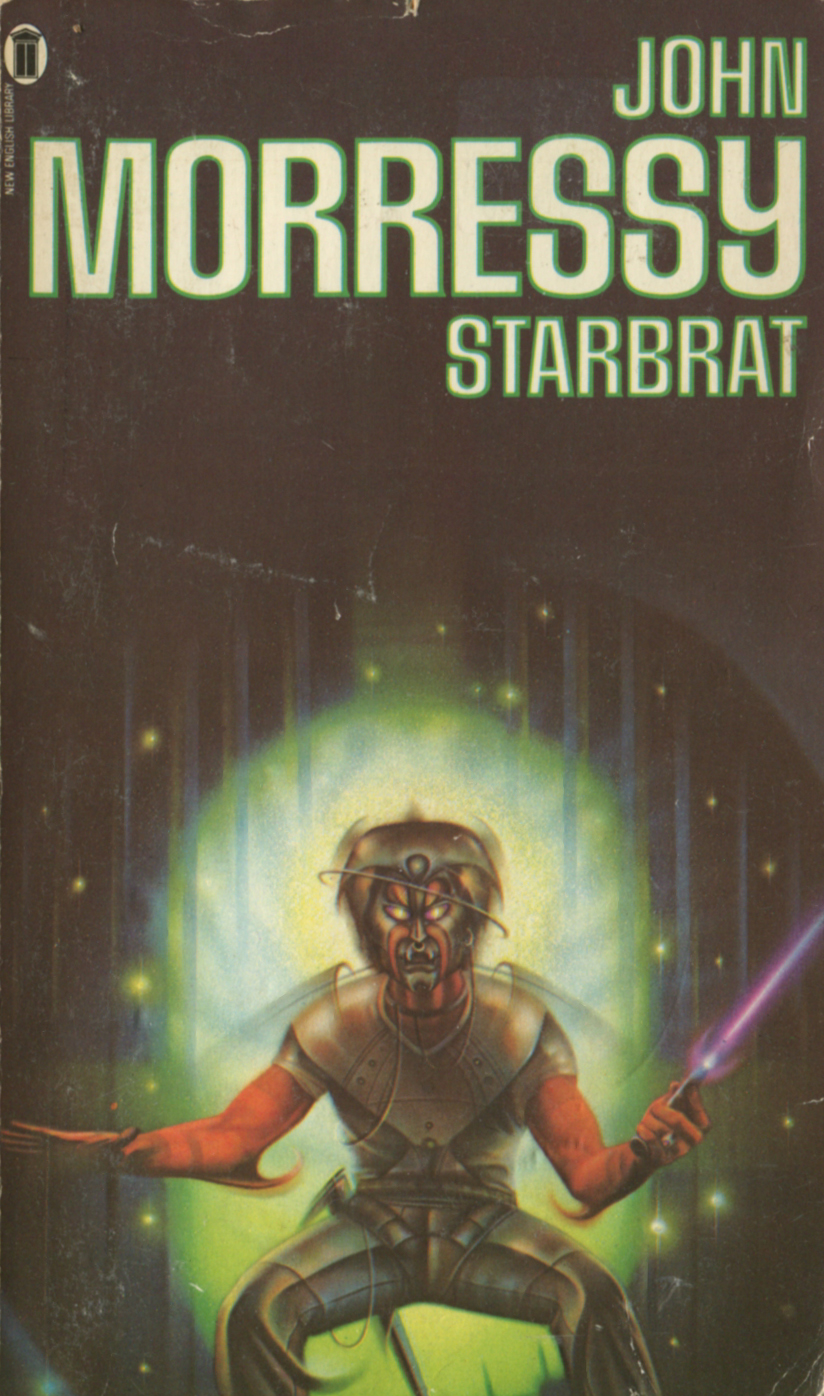 |
| NEL paperback, 1979. Cover artwork by Joe Petagno. |
"DRIVESHIPS ROAM THE STARWAYS,
carrying outlaws, pirates and slavers, for it is six centuries since the Wroblewski Drive sent men into galactic space, far beyond the solar system. Out on the edges of the unknown, the descendants of Old Earth have settled down with the many races of the galaxy, from the gangling, spidery Lixians to the furry, knee-high Quiplids. But space is a frontier, and all too often the only law is a man with a weapon, as it was in the Bloody Centuries On Old Earth.
SLAVE TRADERS
snatched Del Whitby from planet Gilead on the day he learned he was a foundling. From the gladiatorial schools on Tarquin VIII where he learns weapon-skill, to the information banks on Watson's Planet and the barbarities of war-torn Skorat, Del scours the many-peopled worlds of Space for a clue to his origins.
THE TEEMING GALAXY
of Starbrat is also the setting for Nail Down The Stars and Under A Calculating Star. John Morressy, whose science-fiction novels have previously appeared in the United States, has written a tale of adventure, humour and ideas, in a far future when men have won the stars but lost the past."
 |
| Penguin paperback, 1983. Cover art by Tony Robers. |
"Holding a telescope to the future...
When you can race through space on a solar-powered yacht, take a time package-tour back to the crucifixion, enjoy supper with Leonardo da Vinci...
Twelve of science fiction's most inventive writers give us their visions of tomorrow's world in this dazzling galaxy of stories."

